Kimmuh.com

Kimya Mühendisliği

Portable PAFreshney Periodic Table 3.6

Portable PAFreshney 3.6 Size: 14 MB

The application contains all the elements of the along with images of the elements in their natural state, as well as lots of other information and interactive displays.
The now comes in three versions. They all contain the same amount of information.

Features include:
Detailed information on each
Details of isotopes and allotropes
Details of important compounds
Details of reactions with water, air, halogens and acids

Images for each (300+ images in total)
including valence and crystal stucture diagrams
Glossary of terms
Graphs of important properties
Biographies for the important scientists and discoverers
View the states of the elements at any temperature (from 0 – 6000k)
XP style support
Search through all content
shell diagrams of each
Atomic width diagram
Toolbox, 330 physical constants and over 6400 formulae
names and the majority of the applications buttons are now available in eight different languages. Unfortunately there is just too much text for me to translate (100000+ words).
If you are using this in a school / college or other institue of learning and would like to add your own content, or customise existing content,
Version History
3.6

Added information box
For the highlighted , shows;
Name and symbol
Atomic number and mass
Magnetic ordering
Melting and boiling point
Density and electronegativity
Added new “gradients” for use with display mode
right mouse button to select
Added many new properties to graph selection
Added graph information
(shows the values of the graph under the mouse cursor)
Added; click graph to open ’s data page
Added logarithmic mode (base 10)
Added much improved graph selection method
Added graph options
Alter the graph colours
Print and save the current graph
Added many more properties to “ property search” section
Added; save data from “ property search” to a CSV file
Added: units of the selected property will appear as a tooltip above the
parameter name and itscorresponding value box
Added new tab; toolbox
Find constants, equations and chemical formulae

(330 constants, over 6400 formulae)
Added images to biography pages
Added many more tables
Moved the atomic radii tab
(now in the atomic structure tab)
Fixes to the text and minor GUI improvements
Download: (Size: 14,0 MB)
RapidShare

Fluid-Structure Interaction: Modelling, Simulation, Optimisation (Lecture Notes in Computational Science and Engineering)

Interaction: Modelling, Simulation, Optimisation (Lecture Notes in Computational Science and Engineering)

Fluid-Structure Interaction: Modelling, Simulation, Optimisation (Lecture Notes in Computational Science and Engineering)

Interaction: Modelling, Simulation, Optimisation (Lecture Notes in Computational Science and Engineering) ebook for free download.

interactions (FSI), that is interactions of some movable or deformable structure with an internal or surrounding fluid flow, are among the most important and, with respect to both modelling and computational issues, the most challenging multi-physics problems. The variety of FSI occurrences is abundant and ranges from tent-roofs to micropumps, from parachutes via airbags to blood flow in arteries. This volume of LNCSE contains a collection of papers presented at the International Workshop on FSI held in October 2005 in Hohenwart and organized by DFG’s Unit 493 “FSI: Modelling, Simulation, and Optimization”. The papers address partitioned and monolithic coupling approaches, methodical issues and applications, and discuss FSI from the mathematical, informatical, and engineering point of view.

ISBN: 3540345957

Author:

Publisher: Springer

Pages: 394

Publication Date: 2006-09-14

Password:

www.freebookspedia.com


Download

Chemical Engineering Design: Principles, Practice and Economics of Plant and Process Design

Chemical Engineering Design: Principles, Practice and Economics of Plant and Process Design

Chemical Engineering : Principles, Practice and Economics of Plant and Process ebook for free download.

Bottom line: For a holistic view of chemical engineering , this book provides as much, if not more, than any other book available on the topic. Extract from Chemical Engineering Resources review. Chemical Engineering is a complete course text for students of chemical engineering. Written for the Senior Course, and also suitable for introduction to chemical engineering courses, it covers the basics of unit operations and the latest aspects of process , equipment selection, plant and operating economics, safety and loss prevention. It is a textbook that students will want to keep through their undergraduate education and on into their professional lives.* Provides students with a text of unmatched relevance for the Senior Course and Introductory Chemical Engineering Courses* Teaches commercial engineering tools for simulation and costing * Comprehensive coverage of unit operations, and economicsStrong emphasis on HS&E issues, codes and standards, including API, ASME and ISA codes and ANSI standards* 108 realistic commercial projects from diverse industries * A rigorous pedagogy assists learning, with detailed worked examples, end of chapter exercises, plus supporting data and Excel spreadsheet calculations plus over 150 Patent References, for downloading from the companion website* Extensive instructor resources: 1170 lecture slides on CD plus fully worked solutions manual

ISBN: 0750684232

Author: Gavin Towler

Publisher: Butterworth-Heinemann

Pages: 928

Publication Date: 2007-11-01

Password:

www.freebookspedia.com


Download link:Download

Integral Passive Solar Water Heater Book


David A. Bainbridge “Integral Passive Water Heater Book”
Passive Inst | 1981-06 | ISBN: 0933490038 | 104 pages | PDF | 7,9 MB


This book covers the and construction of simple passive water heaters. In my opinion, it is easily the best book ever written on the subject. The book was published in 1981, and is now out of print and difficult to obtain.

Passive Water Heaters:
The water heaters covered in this book make a great DIY project. For a few hundred dollars and a weekend of labor, you can build one of these water heaters. It will pay back its initial cost in a year or two. One of these water heaters can save about 4000 KWH in a year — about the same amount of energy that a 1KW PV costing around $10,000 would save!

The book includes:
How to a passive water heater
How to build a passive water heater
How to install a passive water heater
Examples of many types of designs that would almost any situation
Discussion of potential improvements to the

Download

Some Conventional Process Control Schemes

Some Conventional Control Schemes
Dr Mark J Willis
Department of Chemical and
University of Newcastle upon Tyne
email: mark.willis@ncl.ac.uk
Written: October, 1999
Aims and Objectives
To revise / revisit basic control schemes covered in the second year control
course ( Control I). Schemes to be discussed are:
• Feedback control
• Feedforward Control
• Cascade Control
• Ratio Control
For each scheme a typical example is used to highlight the
application of the methodology.
On completion of this section of the course you should have an awareness of
a common control schemes and a basic knowledge of their
advantages and disadvantages.
Background
Normally a chemical has numerous inputs and many outputs.
Consider the diagram below:
Manipulated Input
Disturbance Inputs

Reboiler
Bottom Product
B, xB
Boilup
V
Condenser
Accumulator
Reflux
L
Distillate
D, xD
Feed
P
F, zF
VT Output (s)
The inputs can generally be classified as:

Chemistry of Petrochemical Processes

by Ph.D., Sami Matar and Ph.D., Lewis F. Hatch
Gulf Professional Publishing|  2001 | ISBN: 0884153150 | 356 pages | pdf| 5 Mb

A quick-reference to petrochemical reactions and products, technology, and polymer synthesis. Provides coverage of the latest developments in the petrochemical industry, and a quick tutorial on the chemical reactions associated with oil and gas processing.

In of Petrochemical Processes, readers find a handy and valuable source of information containing insights into petrochemical reactions and products, technology, and polymer synthesis. The book reviews and describes the reactions and processes involved in transforming petroleum-based hydrocarbons into the chemicals that form the basis of the multi-billion dollar petrochemical industry. In addition, the book includes information on new developments for the production of raw materials and intermediates for petrochemicals that have surfaced since the book’s first edition.

Provides a quick understanding of the chemical reactions associated with oil and gas processing

Contains insights into petrochemical reactions and products, technology, and polymer synthesis.

http://anonym.to/?http://w16.easy-share.com/1700536235.html

chemcraft 1.5.build.286

chemcraft 1.5.build.286


Chemcraft
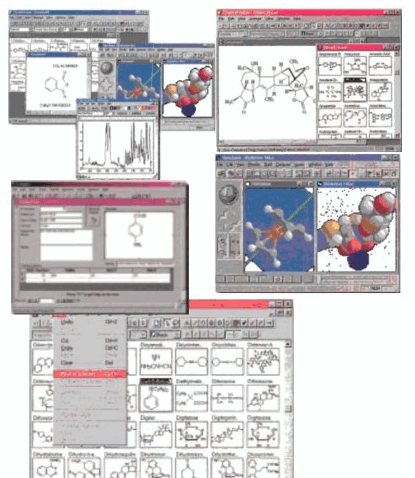
is a Windows-based graphical program for working with quantum computations. It is a convenient tool for visualization of computed results and preparing new jobs for the calculation. Chemcraft is mainly developed as a graphical user interface for Gamess (US version) and Gaussian program packages. For working with other formats of calculations, the possibility to import/export coordinates of atoms in text format can be easily used. Chemcraft does not perform its own calculations, but can significantly facilitate the use of widespread quantum packages.

Features :

The main capabilities of the program include:

Rendering 3-dimensional pictures of molecules by atomic coordinates with the possibility to examine or modify any geometrical parameter in the molecule (distance, angle);

Visualization of Gamess or Gaussian output files: representation of individual geometries from the file (optimized structure, geometry at each optimization step, etc), animation of vibrational modes, graphical representation of gradient (forces on nucleus), visualization of molecular orbitals in the form of isosurfaces or colored planes, visualization of vibrational or electronic (e.g. TDDFT) spectra, possibility to show SCF convergence graph, and some other features;

Different tools for constructing molecules and modifying molecular geometry: using standard molecular fragments, “dragging” atoms or fragments on the molecule’s image, utility for setting a point group, and other possibilities;

Producing publication-ready images of molecules in customizable display modes, containing required designations (labels, lines, etc);

Some additional utilities for preparing input files: visual construction of Z-matrixes, automatic generation of input files with non-standard basis sets, converting MOs read from an output file into the format of input file.

The program combines advanced graphical user interface and wholesome features designed for practical use. Chemcraft provides very detailed structured visualization of output files, based on dividing a file into separate elements and presenting them in hierarchical multi-level list; this feature allows one to easily analyze complicated files, such as scan jobs, IRC jobs, or multi-job calculations. The graphical engine of Chemcraft does not require any hardware acceleration.

Quote:
Homepage

(Size: 1.9 MB)

Download

FieldAlign v2.0.1

FieldAlign v2.0.1 – 8.38 MB

FieldAlign™ is a smart molecular alignment tool for modellers and chemists. Given a 3D template , it can align other molecules entered in 2D to that template rapidly and in a biologically-relevant manner. The template would commonly be an active (or set of molecules) in its bioactive conformation. The template could be obtained from a FieldTemplater™ alignment hypothesis, a ligand extracted from the active site of a protein, docking or pharmacophore studies.

FieldAlign v2.0.1

FieldAlign™ is ideal for visual inspection of alignments of actives from different series and identifying shared field features or pharmacophores, providing a qualitative indication of field SAR. FieldAlign is useful at the early stage of library as small virtual libraries can be aligned to an active template and the chemist can select those scaffolds and monomers which together best match the active field template. FieldAlign can also be used as an aid to lead optimisation: iteratively changing molecules in FieldAlign and observing the alignments and field patterns can provide powerful insights into the direction that your should go. It is also invaluable for overlaying series of molecules prior to 3D QSAR studies where a good alignment of the molecules is critical for obtaining meaningful models.

FieldAlign™ is available as a Linux or Windows GUI program. A Linux command line version is also available which can be readily customized by expert users.

NEW FieldAlign v2.0 has been released! New features include
* Added the ability to add Field Constraints to any field point – force aligments to match specific field points!
* Added access to advanced options in the process dialog – change details of the conformation generation and alignment processes for optimum results
* Added the ability to save calculation settings for future use
* Added copy and paste from ChemDraw/ISISDraw
* Added import of conformation populations – align to your own sets of conformations
* Added the ability to log the calculation steps taken on each and to view the log
* Added the ability to control the shape weighting in the scoring function
* Increased the number of database molecules that can be read into a single project to 500 (from 200)

Homepage

Download: (Size: 8.38 MB)

RapidShare

From Research to Manuscript: A Guide to Scientific Writing

by Michael J. Katz

From Research to Manuscript, written in simple, straightforward language, explains how to understand and summarize a research project. It is a guide that goes beyond grammar and bibliographic formats, by demonstrating in detail how to compose the sections of a paper. This book takes you from the data on your desk and leads you through the drafts and rewrites needed to build a thorough, clear science article. At each step, the book describes not only what to do but why and how. It discusses why each section of a science paper requires its particular form of information, and it shows how to put your data and your arguments into that form. Importantly, this manual recognizes that experiments in different disciplines need different presentations, and it is illustrated with examples from well-written papers on a wide variety of subjects.

As a textbook or as an individual tutorial, From Research to Manuscript belongs in the library of every serious science writer and editor.

Download: http://depositfiles.com/files/4976680

Schaum’s Outline of Heat Transfer

by Donald R. Pitts

Download: http://depositfiles.com/files/5140287

Sayfa 21 / 24« İlk...«1920212223»...Son »